Optimal flight altitude in production
Due to their material properties and the high demands placed on quality and complexity, aerospace components are among the most challenging workpieces in machining. At the same time, manufacturers and suppliers in the industry operate in a highly competitive, global, and innovative market environment with fragile supply chains and fluctuating demand, often with small batch sizes. These conditions have always meant that manufacturing processes in the aviation and aerospace sector must continually set new standards so that users can survive in this market. Only this progress can guarantee long-term competitive production. DMG MORI has been supporting industry leaders and their manufacturing service providers for decades. The consistent further development of manufacturing processes clearly shows that 5-axis technology is the basis for every innovation in the machining of challenging precision components.
Efficient machining of unique geometries
Turbine blades, structural components, and landing gear components—as different as the workpieces in aviation and space may be, they all have one thing in common: their geometries are unique, and the manufacturing processes can only be standardized to a limited extent. In many cases, 5-axis simultaneous milling is absolutely essential in order to be able to produce these geometries at all. It also creates a basis on which such components can be manufactured economically in the working space of a machine – in just a few setups. This reduces throughput times while allowing better utilization of production capacity. Fewer setup changes also lead to greater dimensional accuracy, which benefits consistent quality. With regard to the different materials – the spectrum in aviation and space ranges from aluminum and composites to high-temperature nickel alloys and lightweight, extremely strong titanium alloys – 5-axis machining also allows for optimal tool positioning and thus consistent cutting conditions for demanding materials. This results in longer tool life.
Holistic process integration through 5-axis machining

Beyond these obvious advantages, 5-axis technology is now also used to integrate additional processes. Especially when combined with a mill-turn table, machining centers are becoming multi-talented machines that can efficiently machine rotationally symmetrical components with complex geometries and cover additional process steps such as grinding and in-process measurement. For example, the DMU 125 FDS duoBLOCK from DMG MORI has proven itself to be one of the most popular manufacturing solutions in aviation and space thanks to its versatility—in the high-precision production of a wide variety of components as well as in the field of MRO (maintenance, repair, overhaul). This efficient and holistic machining of aerospace components opens up a further level of productivity enhancement: flexible automation.
Autonomous processes across the entire shop floor
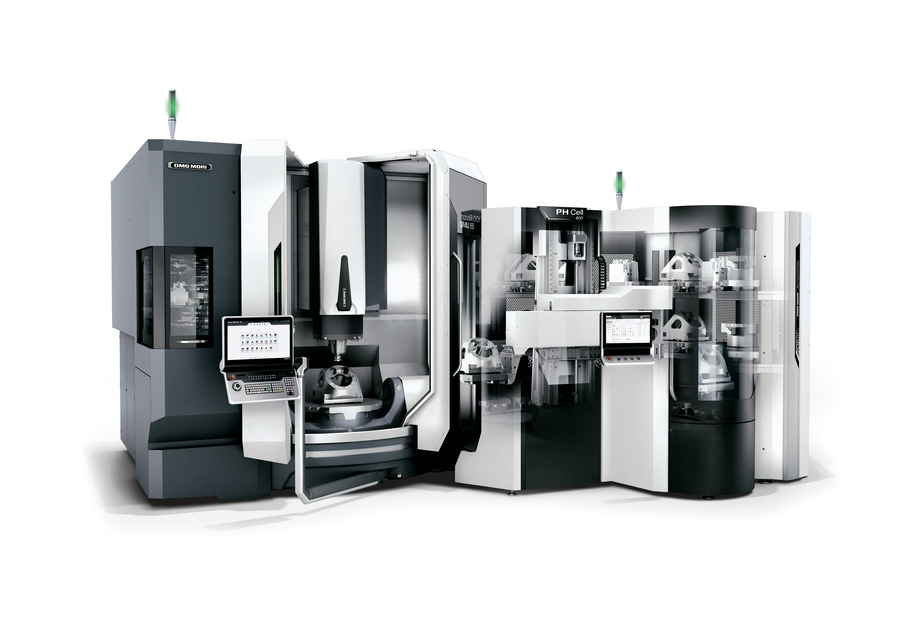
Since aviation and space are characterized by fluctuating demand, small quantities, and changing orders, automation solutions must be individually and flexibly adaptable to a manufacturing process. Unlike in large-scale production, pallet and workpiece handling systems play to their strengths here for small to medium batch sizes. Driverless transport systems also contribute to an automated workflow by handling pallets, tools, or other materials between the machine and the warehouse—working collaboratively alongside people on the shop floor. Such automation solutions can be quickly and easily configured for the respective production environment. In many cases, retrofitting is also possible if users want to take a proven process to a new level of productivity.
5-axis technologies pave the way to the future of manufacturing

The demanding projects in the aviation and space sector offer an ideal environment for developing innovative manufacturing processes. It is a win-win situation for everyone involved, because manufacturers and suppliers can maintain cost-effective production while DMG MORI can test and establish new CNC technologies and peripheral processes—including in other challenging industries. In this context, 5-axis technology provides a stable framework for designing machining solutions in line with Machining Transformation (MX). This is because process integration and automation, alongside Digital Transformation (DX) and Green Transformation (GX), are the cornerstones of this manufacturing model, with which the machine tool manufacturer is paving the way for the future of manufacturing.
